

Choosing a law firm SEO agency is a significant business decision. The right partner should help your firm become easier to find when potential clients search for legal help, while making it clear what work is being done and how its impact will be assessed.
That can be harder than it sounds. SEO proposals often include technical terms, ranking charts, projected traffic, and confident promises. But a polished presentation does not tell you whether an agency understands your practice, whether its work will bring relevant inquiries, or whether your firm will retain control of its website and accounts.
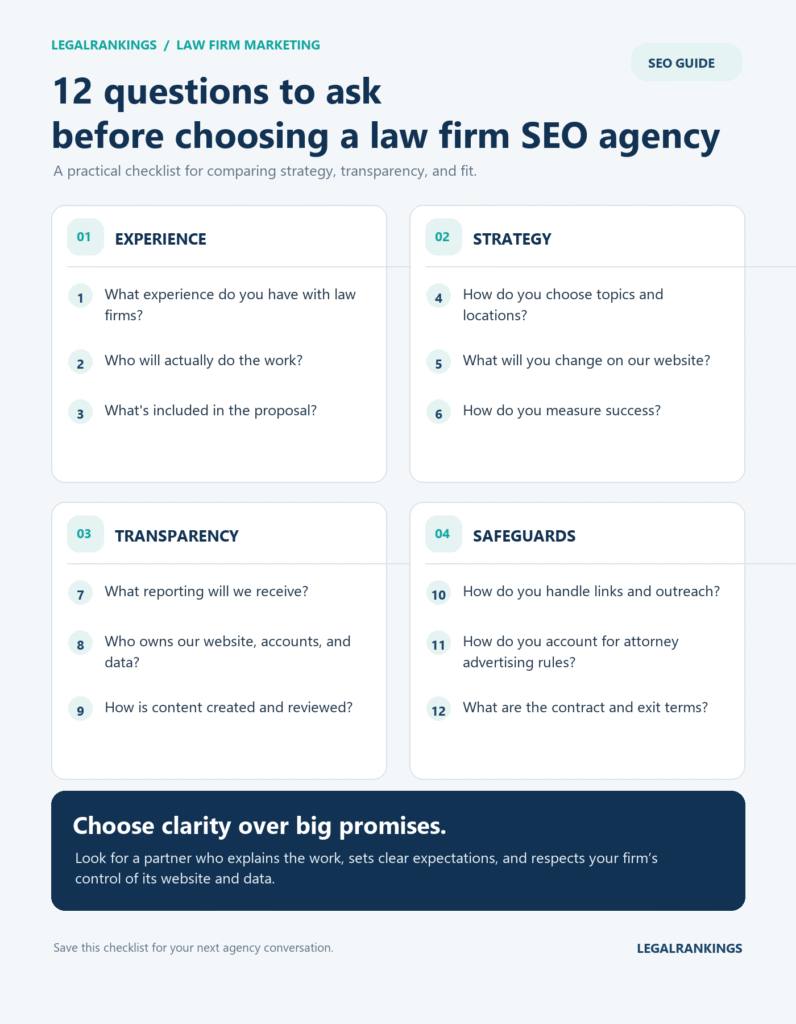
Before you sign, ask direct questions about the agency’s process, experience, measurement, and contract. The answers should help you understand not only what the agency plans to do, but why that work fits your firm.
1. What do you know about marketing law firms?
Legal marketing has its own considerations. A firm may have several practice areas, serve different locations, and need to communicate complex services in language clients can understand. Marketing content may also need attorney review and must be checked against rules that apply to the firm’s jurisdiction.
Ask the agency to explain what it has learned about your practice, the clients you serve, and the places where you want to be visible. A useful answer should go beyond saying that the agency “works with lawyers.” It should show that the team has thought about the difference between, for example, someone looking for general information and someone trying to contact counsel about a specific matter.
Ask for examples of how the agency approaches legal content, local search, website structure, or lead tracking. You are looking for a clear process and relevant experience—not a guarantee that your firm will receive the same outcome as another client. For a broader look at the agency’s advice for firms, see 17 Proven Law Firm Marketing Strategies That Actually Work in 2026.
2. Who will do the work?
The person who presents the proposal may not be the person who will manage your campaign. Find out who will be responsible for strategy, technical work, content, local search, reporting, and account communication.
Ask how often you will speak with the person responsible for your account and who will answer questions between scheduled meetings. Clarify whether work is performed by the agency’s employees, contractors, or a combination. There is no one staffing model that is automatically right, but you should know who is handling the work and how quality is reviewed.
3. What exactly is included in the proposal?
“SEO” can describe many kinds of work. One proposal may focus on technical fixes; another may include local visibility, content planning, link outreach, or website changes. Ask the agency to list the actual deliverables and the expected frequency of each.
A scope might include a technical review, keyword and page research, improvements to existing pages, new content briefs, local listing recommendations, implementation support, reporting, or ongoing planning. The agency should distinguish between work it will complete and recommendations it will send to your firm for implementation.
Ask which tasks are included in the monthly fee, which are one-time projects, and which would cost extra. If the proposal includes content, find out whether that means ideas, outlines, full drafts, editing, attorney review coordination, publishing, or all of those steps.
4. How will you choose the search topics and locations?
A sound SEO plan starts with the firm’s services, target clients, geography, and business priorities. It should not simply produce a long list of popular legal phrases.
Ask how the agency will decide which searches to target and which existing page should address each topic. The plan should make a sensible connection between a search and a useful destination on your website. It should also consider whether the firm can serve the location or case type associated with the topic.
Ask how the agency will avoid creating several pages that compete for nearly the same query. For a firm serving multiple cities or offering multiple practice areas, ask how it will decide when a separate page is useful and when one well-developed page is enough.
5. What will you do with our existing website?
Before proposing a large content campaign or redesign, the agency should review what the firm already has. Your website may contain valuable pages, older content that needs updating, technical barriers to search visibility, or pages that already attract relevant visits.
If you are trying to understand common causes of weak search performance, start with Why Most Lawyers Fail at SEO (and How to Fix It). An agency should explain how its proposed audit will identify the issues that apply to your own site.
Ask what the agency will review before recommending changes. This may include site structure, mobile usability, page titles, indexing, internal links, loading experience, existing search performance, and conversion paths. Ask how it will prioritize changes and whether you will see recommendations before major pages are changed or removed.
6. How do you measure success?
Rankings and traffic can be useful indicators, but they do not tell the whole story. A search visit is not automatically a qualified inquiry, and an inquiry is not necessarily a retained client.
Ask the agency what it will report and how each metric relates to your firm’s goals. Depending on your setup, useful measures could include relevant organic visits, calls or forms from organic search, visibility for selected practice-area or location searches, and the quality of inquiries reported by your intake team.
Ask how the agency separates organic search from paid advertising and other sources. If it uses call tracking or form tracking, clarify what is tracked, how information is handled, and whether your firm retains access to the data. Agree on definitions before the campaign begins so that everyone understands what counts as a lead and what counts as progress. Google Search Console provides site owners with information about how their pages perform in Google Search; see Google’s Search Console documentation.
7. What reporting will we receive?
A report should help you make decisions, not just fill a monthly email. Ask to see a sample with confidential details removed. Look for plain-language explanations of what changed, what work was completed, what the data suggests, and what the agency recommends next.
Ask whether the report will connect activities to outcomes. For example, if the agency publishes a new practice-area page, can it show when it was published, what search intent it was built to address, and how its performance will be reviewed?
8. What access and ownership will our firm retain?
Your firm should understand who owns the website, domain, analytics, Search Console, business listings, content, and advertising accounts. Ask whether the agency will work inside accounts owned by your firm or create accounts under its own control.
Confirm that your team can access the accounts and export important data. If the relationship ends, ask what happens to the content, website changes, tracking setup, and any accounts the agency managed. These terms should be clear in writing.
9. How is content created and reviewed?
Legal website content needs to be clear and accurate. Ask who researches and drafts it, how sources are checked, and how the firm’s attorneys participate in review. The agency can support research and editing, but the firm should decide how legal accuracy and professional obligations are handled.
Ask how the agency will make content specific to your firm rather than recycling generic explanations. Useful content may draw on attorney interviews, anonymized questions clients commonly ask, the firm’s process, or practical details about its services—provided those details are accurate and approved.
If generative AI tools are part of the workflow, ask what they are used for and what human checks take place. Avoid a process that publishes large numbers of lightly edited pages without meaningful review. Google recommends content that is helpful and people-first, and its spam policies describe scaled content abuse as producing many low-value pages primarily to manipulate search. Review Google’s people-first content guidance and Google’s spam policies.
10. How do you handle links and external promotion?
Links from other sites can help people discover your firm, but the methods used to obtain them matter. Ask the agency how it approaches outreach, partnerships, directories, and other external mentions.
Be cautious if the answer centers on buying large quantities of links, private networks, or tactics the agency will not explain. Ask to review the types of sites it plans to contact and how it checks their relevance. No agency should ask you to accept risk without explaining what it will do on your behalf.
11. How do you account for attorney advertising rules?
Rules governing lawyer advertising differ across jurisdictions. Your marketing partner should be willing to work with your firm’s review process instead of treating legal and ethical review as an obstacle.
Ask who approves claims about experience, awards, case results, testimonials, specialties, or expected outcomes. Your attorneys should have the final say on legal claims and on whether content complies with the rules that apply to them. The ABA Model Rule on communications about a lawyer’s services prohibits false or misleading communications, while state rules and interpretations may differ. See ABA Model Rule 7.1. New York firms can also review the New York Rules of Professional Conduct with counsel.
The agency should be comfortable documenting sources and flagging claims that need legal review. Be wary of copy that guarantees results, implies every client will achieve the same outcome, or uses testimonials without appropriate context and approval.
12. What are the contract terms—and how do we leave?
Before signing, review the fee, initial term, renewal process, cancellation notice, deliverables, payment schedule, and any extra charges. Ask what happens if the agency misses a deliverable or the firm needs to pause the work.
Clarify whether the agreement includes setup fees, content costs, software, advertising spend, website development, or third-party services. If the proposal is difficult to compare with another, ask for a simple breakdown by workstream.
Finally, ask what the offboarding process looks like. Your firm should know how access will be transferred, what files and reports it will receive, and which website changes or assets remain available after the engagement ends.
Red flags to take seriously
Consider pausing if an agency:
- Guarantees a specific ranking, number of leads, or revenue outcome.
- Cannot explain its work in plain language.
- Wants control of your domain or analytics without a clear reason.
- Recommends a large volume of generic pages without explaining their purpose.
- Avoids showing reporting examples or naming the people who will work on your account.
- Uses unexplained link tactics or asks you to misrepresent credentials, results, or locations.
- Pressures you to sign before you have time to review the contract.
Make the decision based on fit and transparency
A strong law firm SEO partner should be able to explain its recommendations, connect them to your business priorities, and tell you how it will measure the work. It should welcome questions and make responsibilities clear.
Compare proposals by scope and accountability—not just price or projected traffic. Ask each agency to explain its first steps, what it needs from your team, and what a useful review point will look like.
If you are reviewing your firm’s search visibility and want a clearer picture of where to start, request a free marketing audit or schedule a consultation with LegalRankings. Bring your priorities and questions; the first conversation should help you understand the opportunities, the work involved, and whether the approach fits your firm.
Frequently asked questions
How do I choose an SEO agency for my law firm?
Look for a partner that understands your goals, can explain a clear process, defines the work in writing, reports in plain language, and respects your firm’s control of its website and data. Ask about legal-industry experience, measurement, content review, contract terms, and how the agency responds when results differ from expectations.
How much should a law firm pay for SEO?
There is no single appropriate price for every firm. Costs depend on the scope, competition, locations, website condition, content requirements, and implementation needs. Compare the work included in each proposal rather than selecting by the monthly fee alone.
Can an SEO agency guarantee first-page rankings?
Be skeptical of guarantees about specific rankings. Search results depend on many factors outside an agency’s control, and Google’s own SEO Starter Guide says there are no secrets that automatically secure a first-place position. A responsible partner can set goals, explain the work, and report progress without promising a fixed ranking.
How long should a law firm SEO contract be?
The right term depends on the work and the firm’s needs. Make sure the contract explains the initial term, renewal, cancellation notice, deliverables, and what happens to accounts and work product if the engagement ends. Avoid signing a long commitment you do not understand.
Should our attorneys review SEO content?
Yes. Attorneys should review content that discusses the law, legal services, credentials, case results, testimonials, or other claims about the firm. The agency can support research and drafting, but the firm should own the accuracy and approval process.